
Virtual CFO
- Home
- Virtual CFO
Virtual CFO
Financial Insight for Better Business Decisions
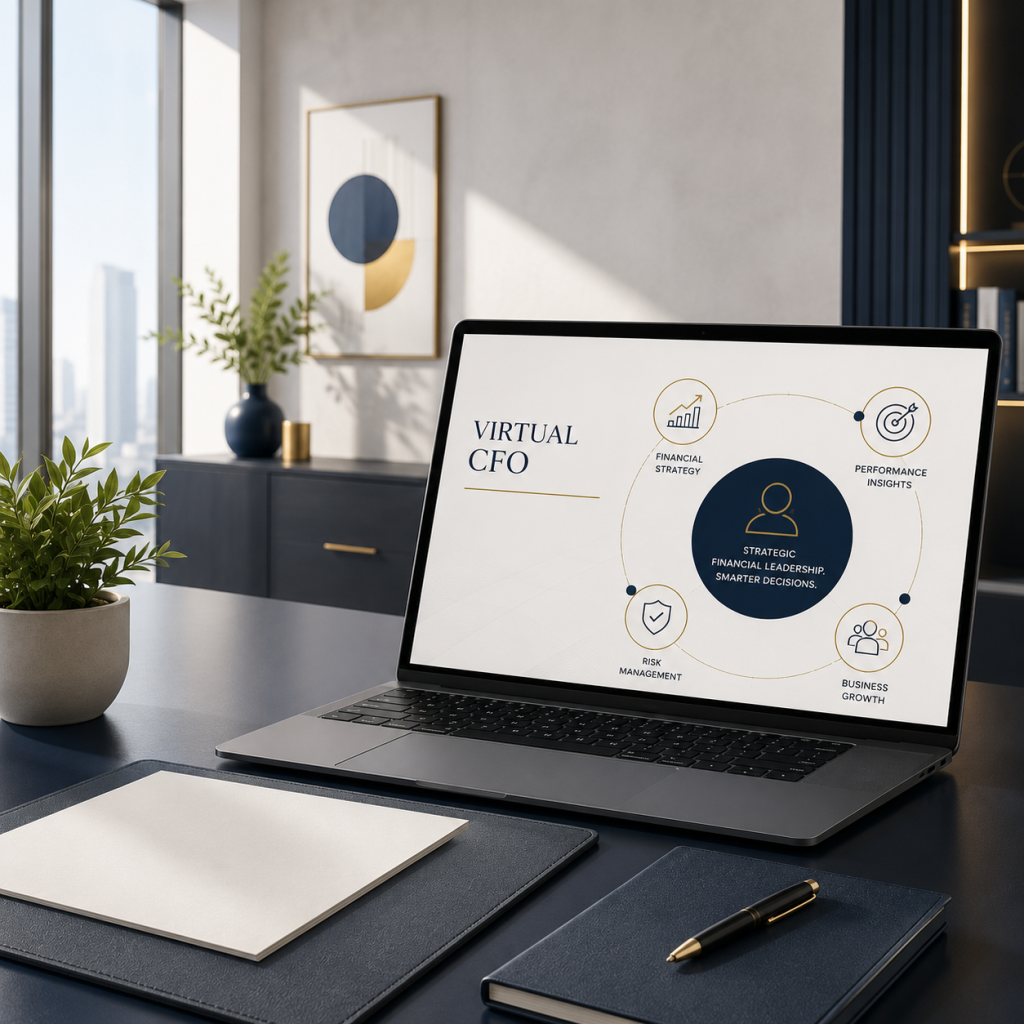
Virtual CFO support gives growing businesses structured financial management without maintaining a full in-house finance leadership function. Prime Regent prepares management reporting, budgets, cash-flow forecasts and KPI analysis, then discusses what the numbers mean for pricing, cost control, hiring and investment decisions. It is the layer that sits above bookkeeping, where accounting information becomes commercially useful.
Most businesses do not lack numbers. They lack the time to work out what those numbers are telling them.
Prime Regent
Senior Financial Input, Without a Full-Time Hire
There is a stage most SMEs reach where bookkeeping alone stops being enough. Revenue is growing but cash feels tight. One product line may be subsidising another and nobody is certain which. A hire, a lease or an expansion is being considered without a clear view of what it does to the cash position over the next twelve months. These are financial management questions, and they need more than a monthly set of accounts.
Prime Regent provides that input on a defined basis. We prepare monthly management reports with commentary, analyse profitability by line or division, monitor cash flow, build budgets and forecasts, track agreed KPIs, review budget against actual performance and examine working capital and cost structures. Recommendations relate to financial management and business performance; we do not provide regulated investment advisory services.
The areas we typically analyse:
| Financial Area | Analysis | Management Value |
|---|---|---|
| Cash Flow | Inflow and outflow patterns and short-term projections | Commitments planned with confidence |
| Profitability | Margin review by product, service or division | Effort directed at what actually earns |
| Budgeting | Annual and departmental budget preparation | Spending measured against a plan |
| Forecasting | Forward projections under different assumptions | Decisions tested before they are made |
| Working Capital | Collection, payment and stock cycle review | Cash released from the operating cycle |
- Monthly management reports
- Profitability analysis
- Cash-flow monitoring
- Budget preparation
- Financial forecasting
- Revenue analysis
- Expense and cost-control review
- KPI tracking
- Budget versus actual reporting
- Working capital analysis
- Financial projections
- Business performance reviews
How We Work
Our Virtual CFO Engagement
Virtual CFO support works on a rhythm rather than as one-off advice. Reporting, review and forward planning repeat each period, so the picture keeps improving as the business changes.
We start with what management is trying to decide: growth plans, margin pressure, cash constraints or investment questions, and which figures are needed to answer them.
Current results, margins, cost structure, working capital cycle and cash position are reviewed to establish a factual baseline before any forecasting begins.
Budgets, forecasts and the KPIs that genuinely reflect performance in your sector are built, so results can be measured against a plan rather than against last month alone.
Each period we issue management reporting with budget-versus-actual comparison and written commentary explaining the movements that matter and what is driving them.
We review the numbers with you at an agreed frequency, work through options for the decisions ahead and update forecasts as circumstances change.
FAQ
Virtual CFO Questions Answered
What owners and managers usually want to understand before bringing in Virtual CFO support, and how it differs from the accounting they already have.
It is senior financial input provided on a part-time or outsourced basis. Instead of employing a full-time finance director, a business receives management reporting, budgeting, forecasting, KPI analysis and regular financial discussions from an external team at an agreed scope and frequency. It suits companies that have outgrown basic bookkeeping but do not yet need a permanent senior finance hire.
Bookkeeping records what has already happened and produces accurate statements. Virtual CFO work starts from those statements and asks what they mean: why margins moved, where cash is being consumed, whether a plan is affordable and what the next twelve months look like under different assumptions. One is backward-looking and essential; the other is forward-looking and built on top of it.
Typically businesses that are growing faster than their finance function, those carrying several revenue lines and unsure which are genuinely profitable, companies with cash-flow strain despite reported profit, and owners preparing for expansion, funding or a significant investment. Size matters less than complexity: an SME with multiple divisions often needs it more than a larger single-line business.
Yes. Budgets are prepared annually and can be broken down by department, branch or project, with monthly phasing so performance can be tracked through the year. Forecasts are built on your own historical data and the assumptions you provide, and can be modelled under different scenarios so the effect of a decision is visible before it is taken.
Monthly reporting suits most businesses, with a review meeting either monthly or quarterly depending on how quickly conditions change. Some clients prefer a weekly cash-flow update during tighter periods or while a major project is running. The frequency is agreed at the start and can be adjusted as circumstances require.