
VAT Services
- Home
- VAT Services
VAT Services
Practical VAT Support for UAE Businesses
Prime Regent provides VAT services for businesses in Dubai and across the UAE, covering registration, return preparation, transaction review and record maintenance. We check that input and output VAT are captured correctly, reconcile the VAT accounts to the ledgers and keep the supporting documentation organised, so each return period is prepared from records that already reconcile rather than from figures assembled at the last minute.
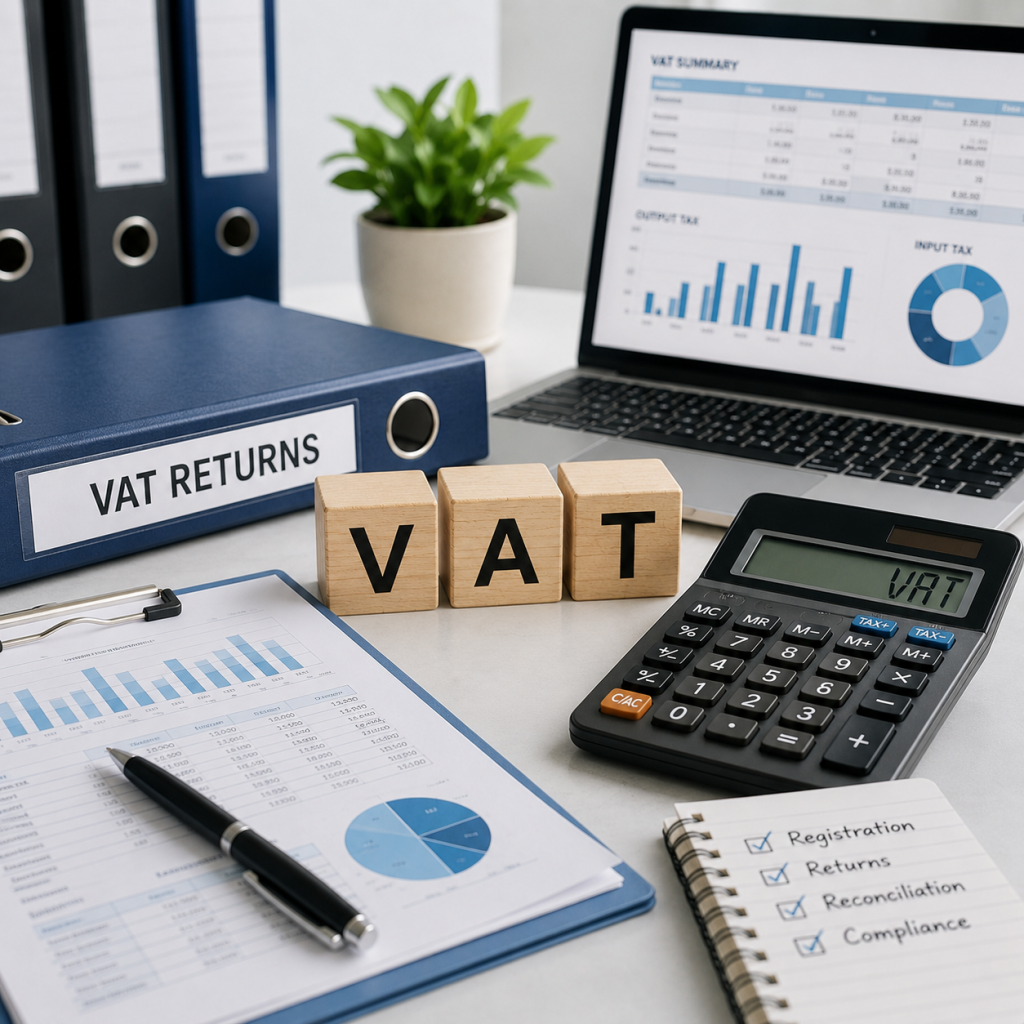
A VAT return is only as accurate as the transaction records it is prepared from.
Prime Regent
VAT Handled as Part of Your Accounting
VAT problems rarely start at the return. They start earlier, in how invoices are raised, how supplier documents are captured, how import and export transactions are treated and whether input tax has been recovered on items that genuinely qualify. By the time a return period closes, those decisions are already sitting in the ledger, which is why VAT is best handled as part of routine accounting rather than as a separate exercise every quarter.
Prime Regent assists businesses with VAT registration and deregistration, prepares and reviews returns, reconciles VAT control accounts, checks tax invoices and credit notes for the required details, and reviews historical periods where something looks inconsistent. Where records have gaps, we complete the underlying accounting first. The objective is straightforward: returns that are supported by documentation, and a business that knows where its VAT position stands.
How our VAT support is structured:
| VAT Requirement | Prime Regent Support | Outcome |
|---|---|---|
| Registration | Assistance with VAT registration and deregistration | Obligations addressed at the right time |
| Transaction Review | Checking treatment of sales, purchases, imports and exports | Fewer misclassified transactions |
| Return Preparation | Compiling input and output VAT for the period | Returns prepared from reconciled data |
| Reconciliation | Matching VAT control accounts to the general ledger | Differences identified before filing |
| Record Keeping | Organising tax invoices, credit notes and customs documents | Documentation available on request |
- VAT registration assistance
- VAT deregistration assistance
- VAT return preparation
- VAT filing support
- Input and output VAT review
- VAT control account reconciliation
- Tax invoice and credit note review
- Input tax recovery review
- Import and export transaction accounting
- VAT record maintenance
- VAT health check
- Historical transaction review
How We Work
Our VAT Return Cycle
Each VAT period follows the same working pattern, so nothing is left to the final week. You know which documents we need, when the draft figures are ready and what is being checked before anything is submitted.
We look at your registration status, tax periods, business activities and the way sales and purchases are currently treated in the accounts.
Sales invoices, supplier tax invoices, credit notes, customs documentation and bank records for the period are collected through an agreed routine.
Transactions are reviewed for correct VAT treatment, including zero-rated and exempt items, reverse charge entries and input tax that may not be recoverable.
VAT control accounts are reconciled to the ledger, differences are investigated, and the return figures are prepared with a supporting summary for your review.
We assist with the submission, then keep the VAT records maintained through the following period so the next return starts from a reconciled position.
FAQ
VAT Questions Answered
Questions we are regularly asked about VAT registration, returns and record keeping in the UAE. Anything specific to your transactions is best discussed directly with our team.
Registration is driven by taxable supplies and imports measured against the applicable thresholds, with mandatory and voluntary levels applying at different points. Because the calculation depends on what counts as a taxable supply for your particular activities, we review your revenue records and explain where the business stands, based on applicable requirements, rather than working from a general rule of thumb.
Sales invoices for the period, supplier tax invoices supporting input tax, credit notes issued and received, import and export documentation, bank statements and the general ledger. Tax invoices need to carry the required details to support recovery. We work from this documentation directly, and flag anything missing early enough in the period for it to be obtained.
Yes. A review of earlier periods often surfaces misclassified transactions, input tax claimed without a valid tax invoice, missed reverse charge entries or VAT accounts that no longer reconcile to the ledger. We set out what we find and what can be done about it, so you can decide on the appropriate course of action with a clear picture.
Yes. Where a business has ceased making taxable supplies or has fallen below the applicable threshold, we assist with preparing the deregistration information and making sure outstanding periods and records are in order first. Deregistration generally goes more smoothly when the final return and the VAT ledger balances have already been reconciled.
Monthly reconciliation is the practical approach, even when returns are filed quarterly. It keeps each period small, surfaces coding errors while the paperwork is still recent, and means the return itself becomes a compilation exercise rather than an investigation. For businesses with high transaction volumes, we reconcile as part of the routine monthly close.