
Financial Reporting
- Home
- Financial Reporting
Financial Reporting
Financial Reports That Help You Understand Your Business
Prime Regent prepares structured financial reports for businesses in Dubai and across the UAE: profit and loss statements, balance sheets, cash-flow summaries, ageing analyses and monthly management accounts. Recording transactions is one thing; presenting them so that owners and managers can see what is actually happening to margins, liquidity and obligations is another. Our reporting work is built around the decisions you need to make.
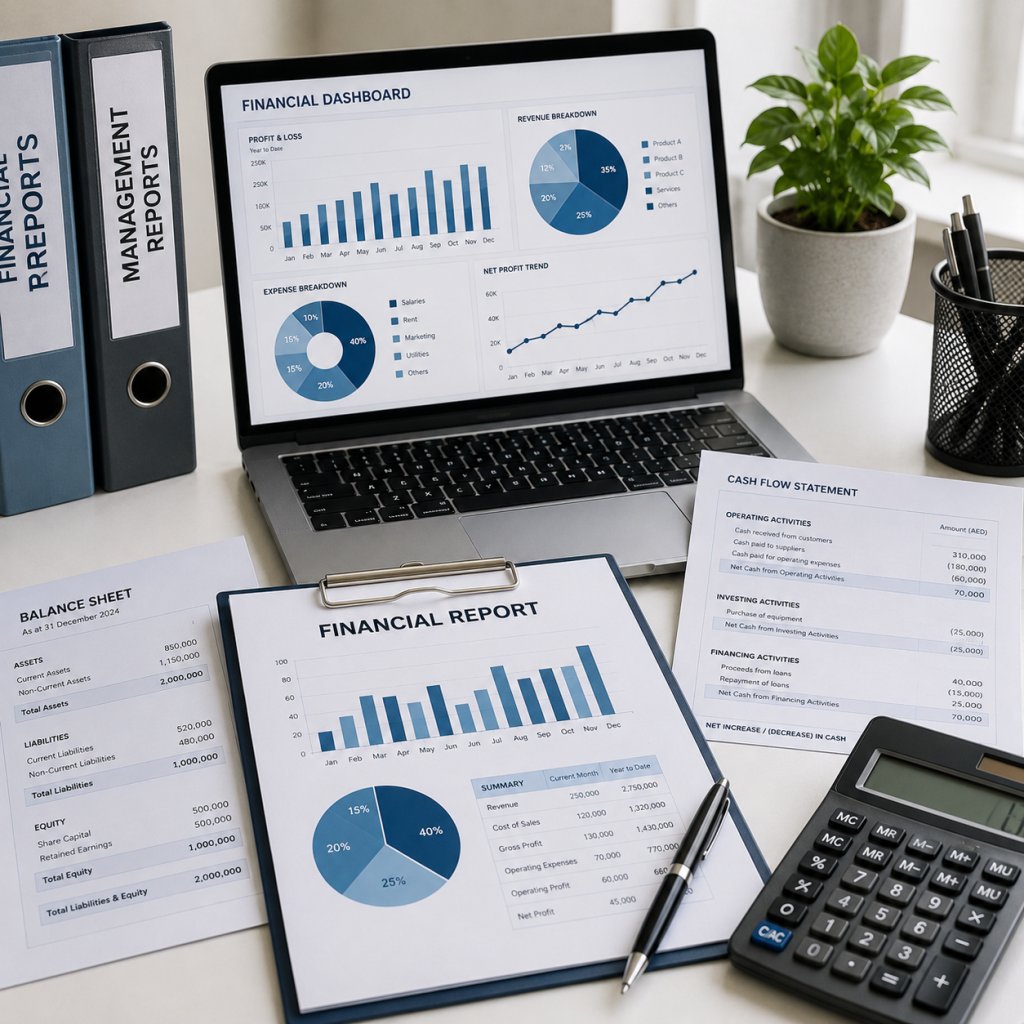
Recording what happened is bookkeeping. Explaining what it means is reporting.
Prime Regent
From Recorded Transactions to Real Insight
Most businesses can produce a set of numbers. Fewer can explain why the gross margin moved three points, why profit is up while the bank balance is down, or which customers are quietly funding the working capital gap. That difference sits between raw accounting data and structured financial reporting, and it is usually the difference between reacting to problems and anticipating them.
Prime Regent prepares reporting packs that answer those questions in plain business language. Depending on what your business needs, that can mean a monthly management pack with commentary, comparative reports against prior periods, receivable and payable ageing analyses, expense and revenue breakdowns by line or department, or year-end schedules prepared for review. We can work from records we maintain, or from your existing bookkeeping where the underlying data is sound.
The reports we most commonly prepare:
| Report | What It Shows | How Management Uses It |
|---|---|---|
| Profit & Loss | Revenue, cost of sales, expenses and result for the period | Tracking margins and cost movements |
| Balance Sheet | Assets, liabilities and equity at a point in time | Assessing financial position and obligations |
| Cash-Flow Report | Where money came from and where it went | Understanding liquidity behind the profit figure |
| Receivable Ageing | Outstanding customer balances by age bracket | Prioritising collection activity |
| Management Report | Key figures, comparatives and supporting commentary | Reviewing performance month to month |
- Profit and loss statements
- Balance sheets
- Cash-flow statements
- Trial balance preparation
- General ledger reports
- Receivable ageing analysis
- Payable ageing analysis
- Expense analysis
- Revenue analysis
- Monthly management accounts
- Comparative period reports
- Year-end schedules
How We Work
Our Reporting Cycle
Reporting is only useful if it arrives on time and answers the right questions. We agree the format and delivery date at the start, then follow the same cycle each period so the pack becomes something you can plan around.
We discuss which decisions the reports should support, which comparatives matter and whether reporting is required by department, branch, project or the business as a whole.
Before reports are built, ledger balances and reconciliations are reviewed, because a well-formatted report drawn from unreliable data is worse than no report at all.
We set the reporting format, groupings and comparatives, so each period is presented consistently and figures can be tracked from one month to the next.
The pack is prepared and issued with commentary on the movements that matter, in business language rather than accounting terminology.
We walk through the figures with management, answer questions and adjust the reporting format as the business and its priorities change.
FAQ
Reporting Questions Answered
What business owners usually want to know about financial reports, management accounts and how often they should be reviewed.
For most businesses the core monthly set is a profit and loss statement, a balance sheet and a receivable ageing report, supported by a cash position summary. Together these show whether the business is profitable, what it owns and owes, who owes it money and whether cash can cover near-term commitments. Additional reports are added where the business model calls for them.
It shows revenue earned in a period, the direct costs of delivering it, operating expenses and the resulting profit or loss. Read alongside a prior period or a budget, it becomes far more useful, because the movements are what carry the information: a margin slipping gradually over several months tells you something a single month's figure never will.
Yes. A management pack typically combines the core statements with comparatives, key ratios, ageing analyses and short written commentary on notable movements. It is prepared to an agreed timetable after the monthly close, so management is reviewing recent information rather than figures that are already several months old.
They should be. A trading company, a services firm and a contracting business each need different views of the same underlying data. We can report by branch, department, project, product line or cost centre, provided the chart of accounts supports that split. Where it does not, we can restructure it so future periods report the way you need.
Yes, and many clients start that way. We review the existing records first to confirm they are complete and reconciled, since reporting from unreliable data produces confident-looking but misleading conclusions. If corrections are needed, we identify them and agree the work before reporting begins.